Cookie settings

Choose what this site can use. You can change it any time from Cookie settings at the foot of the page. Cookie policy

Skip to the form New Connect Claude, ChatGPT or Copilot to GovConnex through MCP Connect Claude, ChatGPT or Copilot via MCP Read more
Request a demo

Reports 14-page PDF

NSW Election 2027: Four months out

Where the polls stand, how preferences change the race, and 34 seats to watch before NSW votes on 13 March

By Ben Raue, Electoral analyst
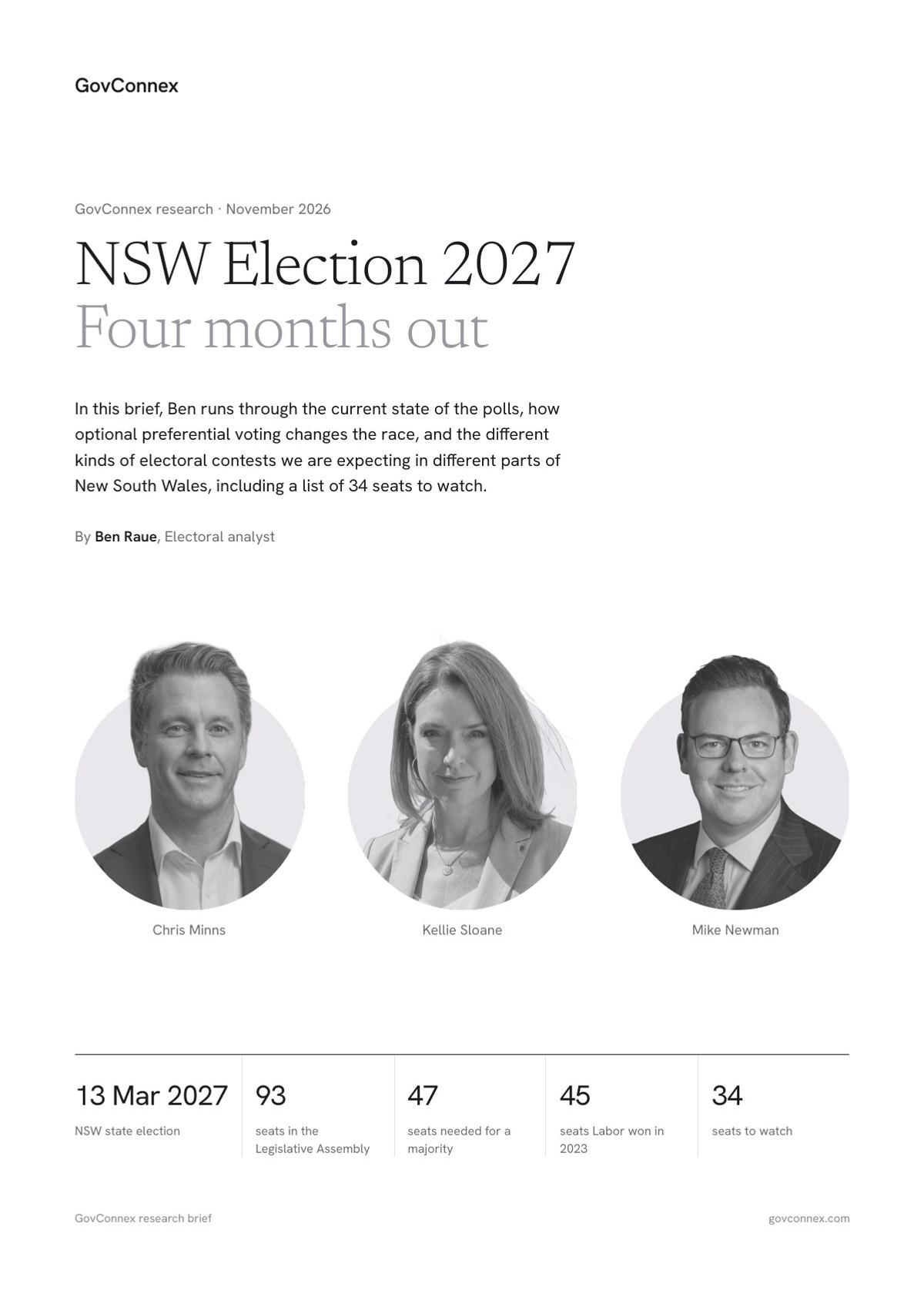
NSW votes on 13 March 2027. Four years after a respectable loss of power, the Coalition is polling at very low levels and One Nation's support has surged, but the Minns Labor government is also polling at low levels. Ben Raue looks at where the polls stand and how optional preferential voting changes the race.

The brief identifies 34 seats to watch across four kinds of contest: outer suburban fringe seats, mid and inner suburban seats, rural seats, and teal and Green seats. It closes with the upper house, where current polls would leave the balance of power with the crossbench.

The full report · 14 pages, with every chart.

Get the full report

What we found

1. One Nation is polling above the Coalition

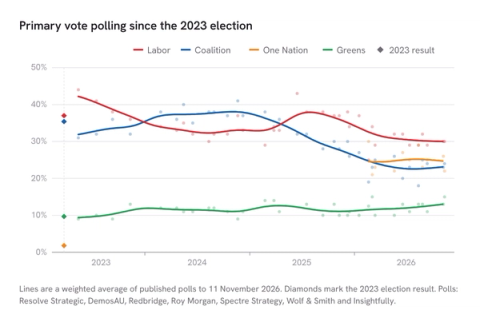
One Nation was added to NSW state polling at the start of 2026 and has tended to poll above the Coalition but behind Labor since. Some recent polls have Labor under 30%, still well ahead of One Nation and the Coalition in the low to mid 20s.
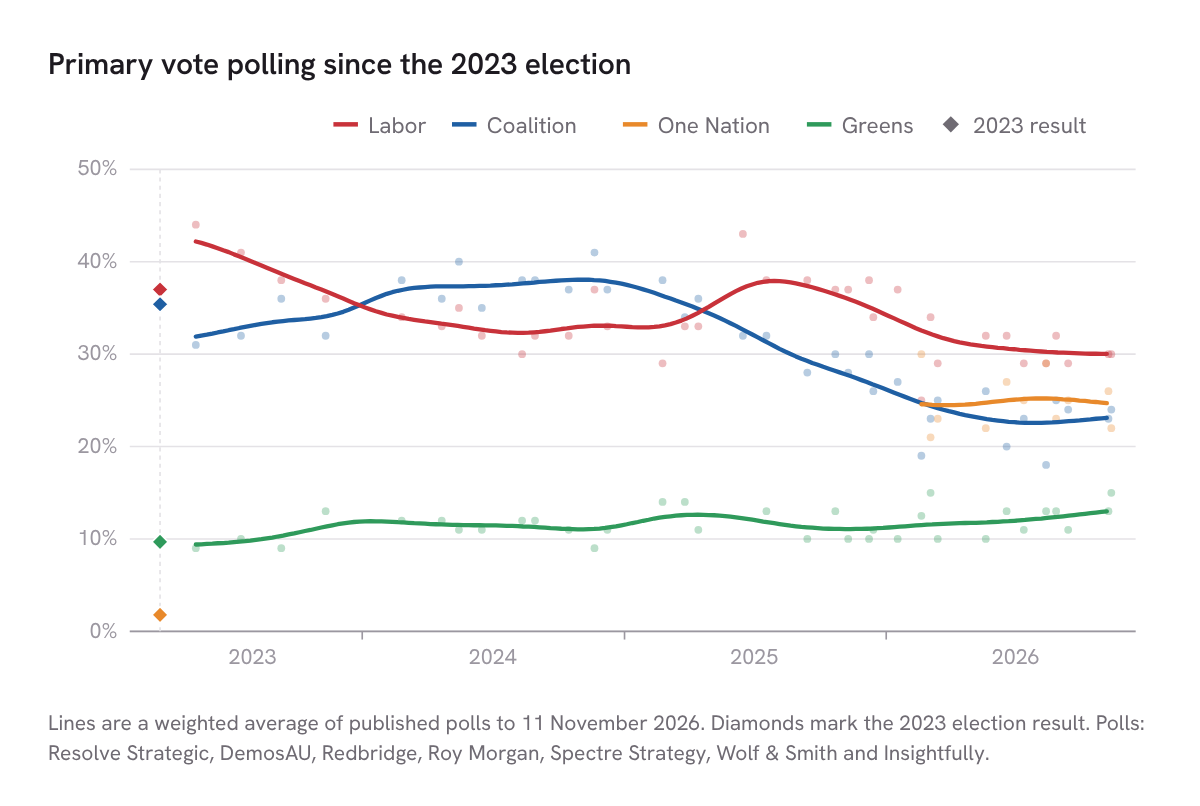
Line chart of NSW primary vote polling since the 2023 election. Labor fell from the low 40s to about 30%, the Coalition from the high 30s to the low to mid 20s, and One Nation has polled in the low to mid 20s since it was added to polls in 2026. The Greens have held steady around 12%. Open the full-size chart
Figure 1. Weighted average of published polls to 11 November 2026. Resolve Strategic, DemosAU, Redbridge, Roy Morgan and others.

2. Optional preferential voting gives Labor an edge

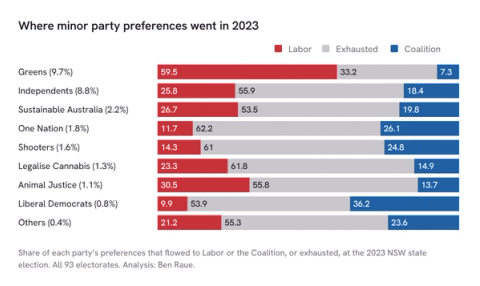
NSW voters can mark a single 1, so many preferences exhaust. At the 2023 election just over a quarter of One Nation preferences flowed to the Coalition and over 60% exhausted, while Greens preferences flowed strongly to Labor. With a higher primary vote, Labor is less reliant on preferences than its rivals.
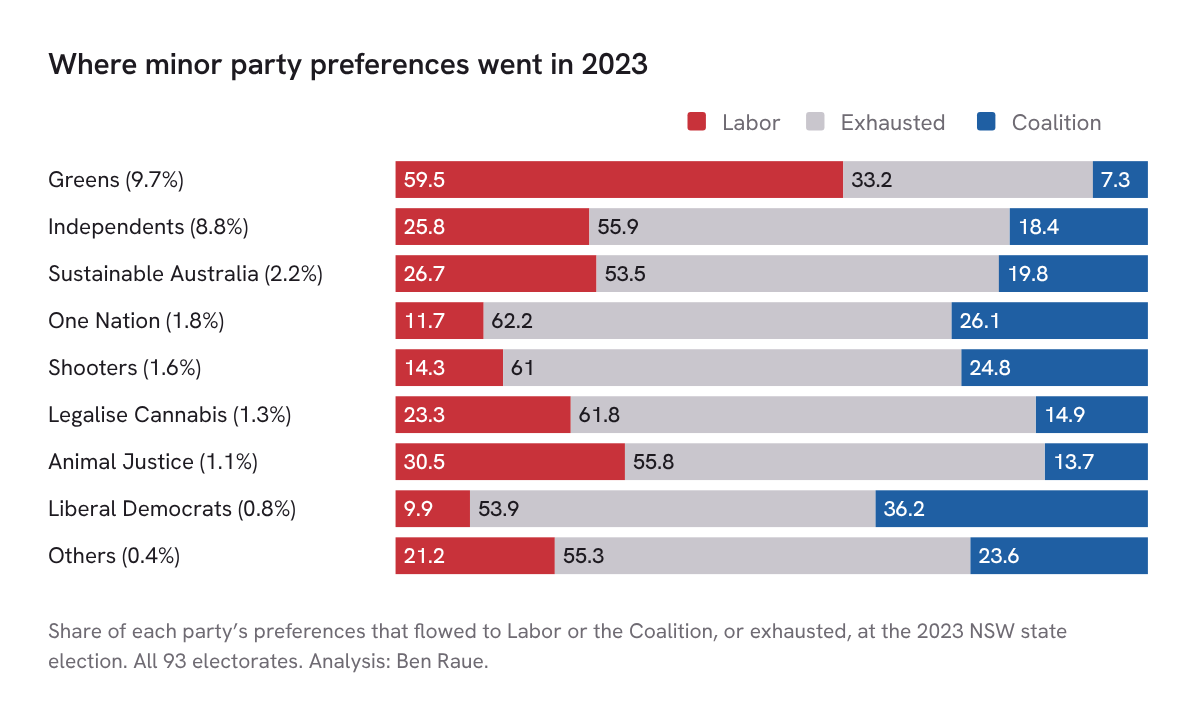
Stacked bar chart of 2023 preference flows. Greens preferences went 59.5% to Labor, 7.3% to the Coalition and 33.2% exhausted. One Nation preferences went 11.7% to Labor, 26.1% to the Coalition and 62.2% exhausted. Open the full-size chart
Figure 2. Preferences from each minor party at the 2023 NSW state election, all 93 electorates. Analysis: Ben Raue.

3. 34 seats to watch across four kinds of contest

Fourteen outer suburban fringe seats are likely to become Labor and One Nation contests. Seven mid and inner suburban Liberal seats may be vulnerable to Labor. Eight rural seats could see One Nation break through, and five teal and Green seats complete the list.

4. The upper house could be split almost evenly

On current polls, Labor and the Greens would hold almost half the Legislative Council, and the Coalition and One Nation almost half, with the balance of power held by the remaining crossbench. One Nation could win five or six of the 21 seats up for election.
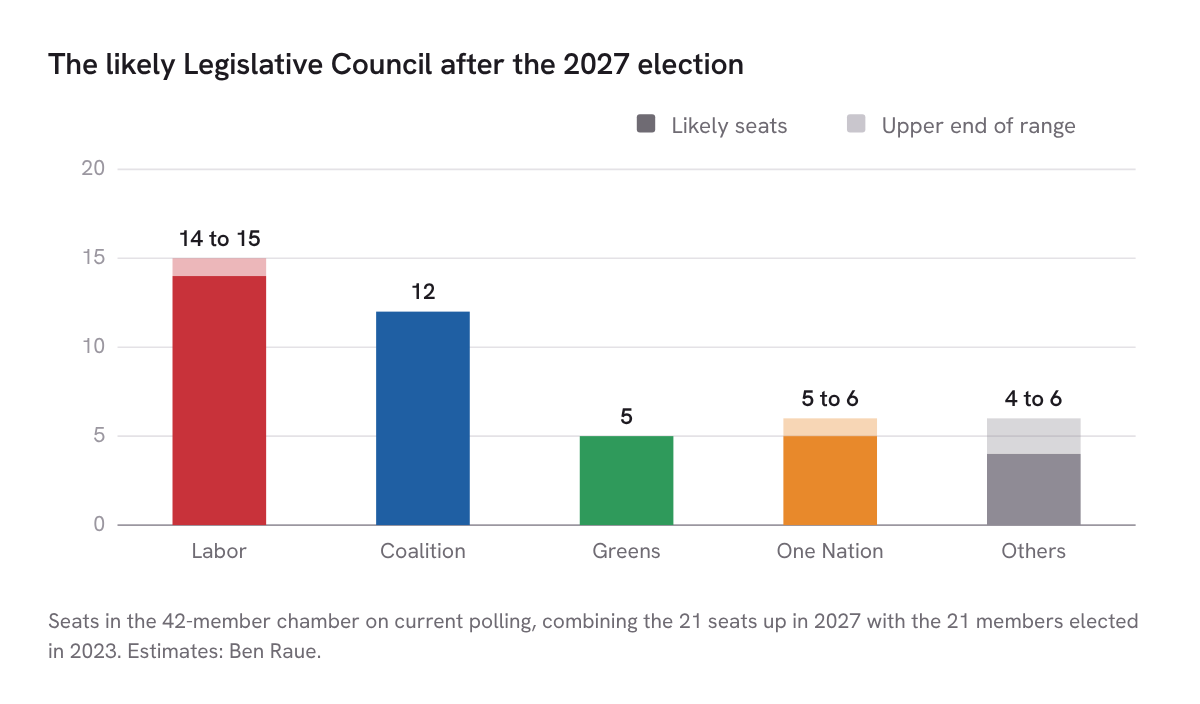
Bar chart of the likely Legislative Council after 2027: Labor 14 to 15 seats, Coalition 12, Greens 5, One Nation 5 to 6 and others 4 to 6, in a chamber of 42. Open the full-size chart
Figure 4. Likely seats in the 42-member chamber on current polling. Estimates: Ben Raue.

What’s in the report

  • A first-term Labor government p. 3
  • The state of play p. 4
  • The impact of optional preferential voting p. 5
  • The contest in different parts of the state p. 8
  • The upper house p. 14

How we counted

There is no current electorate-level polling. The seats to watch come from a model that applies the trends in current state polling to each electorate, rather than listing the seats that were close in 2023. Preference flows are from the 2023 NSW state election.

Get the full report

14 pages, with every chart. We’ll send you updates from GovConnex too.

Country
The PDF downloads straight away.

By submitting your information, you agree to GovConnex’s Privacy Policy. GovConnex needs the contact information you provide to us to contact you about our products and services. You may unsubscribe from these communications at any time.

Keep reading

  • GovConnex ReportNovember 2026 Report · · 18 pages Victorian Election 2026: Preview Who could form government in Victoria, how votes may turn into seats, and the 52 seats to watch on 28 November
  • GovConnex ReportOctober 2026 Report · · 19 pages The multicultural marginals Where Australia’s diverse suburbs could decide the next election, and whether One Nation can compete there
  • GovConnex ReportSeptember 2026 Report · · 13 pages Where are the teals? Where the teal independents stand after 2025, and whether they could decide the next government
Know first. Prove the impact. Book a time with our team. Request a demo
  1. About you
  2. A time

Let’s set up your demo.

A few details, then pick a time with our team.

By submitting your information, you agree to GovConnex’s Privacy Policy. GovConnex needs the contact information you provide to us to contact you about our products and services. You may unsubscribe from these communications at any time.

Trusted by government relations teams at

  • BHP
  • Novartis
  • Virgin Australia
  • The University of Sydney
  • QBE
  • SEC Newgate

Your demo

    Bring your team

    You’re meeting The GovConnex team

    Where
    Google Meet

    Join from your browser, no Google account needed. Your invite has the link, and a way to move the time.